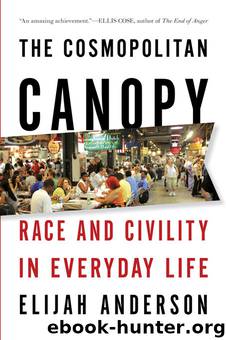
The Cosmopolitan Canopy: Race and Civility in Everyday Life by Elijah Anderson
Author:Elijah Anderson [Anderson, Elijah]
Language: eng
Format: azw3
Publisher: W. W. Norton & Company
Published: 2011-03-27T16:00:00+00:00
LIBERTY PLACE
In Center City, not far from Rittenhouse Square, rises Liberty Place. A pair of elegant office towers, this marvel of architectural design in metallic blue glass serves as testimony to the city’s renaissance and supports Philadelphia’s claim to be a world-class destination. The buildings are state-of-the-art in their physical as well as social environment. Compared with the Reading Terminal Market or the Gallery Mall, this setting is decidedly upscale and rather antiseptic. Almost everything is clean, orderly, and safe, effectively monitored by security—young black people, male and female, clad in crisp white shirts and dark blue pants. That the trash cans are seldom allowed to overflow is the kind of minor detail that makes a significant difference. Things are a bit more uptight here, spiffy and formal, than in the street outside.
The food court, located on a mezzanine that looks out onto the atrium, features an array of stalls and an open floor plan for casual dining. Its ambiance expresses a contemporary spirit of possibility. Most of the customers come from offices of the national and regional corporations located here; others work in retail businesses nearby. Residing in the city’s rich variety of local ethnic and suburban neighborhoods, people of all colors meld, but the polished young black individuals stand out, displaying a look of cultivation and poise. They interact amid a multiracial group of middle managers, secretaries, accountants, administrative assistants, and salesclerks who all share tables. Customers occasionally wander in from the upscale boutiques and stores of the mall area or from the hotel that is a part of this complex.
The blue-and-gray glass interior has a corporate feel. Built in 1987 and in 1990, the huge modern structures showcase space that is airy, the marble unmarred. Dining tables are regularly bussed, and trash is picked up frequently. The message is clear that every well-behaved person is welcome here, regardless of his or her background. Clerks and servers are Latino, Asian, black, and white, and the clientele to some degree mirror this mixture. A cosmopolitan aura prevails. Decorum is subtly yet effectively enforced. The homeless or mentally ill who come here seeking to escape the summer heat or winter cold are discouraged by the security guards, who are savvy enough to understand the cues such undesirables display.
As they carefully read the crowd, the guards generally know whom to discourage, seldom misinterpreting the signals people give off. The guards’ behavior is something of a performance for those who partake of this public space. Their actions communicate that the norms observed here set certain limits on allowable behavior. Panhandling is strictly forbidden, and on occasion the guards demonstratively escort a person to the door or put him out, discouraging return trips and informing onlookers about the rules of this place. Only a few homeless persons seem not to get the message; those repeat violators are well known to the guards, who eye sketchy-looking visitors suspiciously.
The food court is unusually active today, its small shops offering a variety of cuisines. Its denizens include well-dressed workers from the adjacent downtown area.
Download
This site does not store any files on its server. We only index and link to content provided by other sites. Please contact the content providers to delete copyright contents if any and email us, we'll remove relevant links or contents immediately.
| Anthropology | Archaeology |
| Philosophy | Politics & Government |
| Social Sciences | Sociology |
| Women's Studies |
Nudge - Improving Decisions about Health, Wealth, and Happiness by Thaler Sunstein(7689)
The Fire Next Time by James Baldwin(5421)
iGen by Jean M. Twenge(5403)
Adulting by Kelly Williams Brown(4561)
The Sports Rules Book by Human Kinetics(4377)
The Hacking of the American Mind by Robert H. Lustig(4363)
The Ethical Slut by Janet W. Hardy(4236)
Captivate by Vanessa Van Edwards(3835)
Mummy Knew by Lisa James(3680)
In a Sunburned Country by Bill Bryson(3528)
The Worm at the Core by Sheldon Solomon(3483)
Ants Among Elephants by Sujatha Gidla(3458)
The 48 laws of power by Robert Greene & Joost Elffers(3219)
Suicide: A Study in Sociology by Emile Durkheim(3009)
The Slow Fix: Solve Problems, Work Smarter, and Live Better In a World Addicted to Speed by Carl Honore(3001)
The Tipping Point by Malcolm Gladwell(2903)
Humans of New York by Brandon Stanton(2864)
Handbook of Forensic Sociology and Psychology by Stephen J. Morewitz & Mark L. Goldstein(2691)
The Happy Hooker by Xaviera Hollander(2682)
